Contents
- The quick answer
- US paper sizes (ANSI)
- European paper sizes (ISO A series)
- US vs European sizes side by side
- Business card sizes
- Paper weights: pounds vs grams
- Tips for printing across both systems
Letter or A4? Tabloid or A3? If you work with clients, partners or printers outside North America, you will run into a second set of paper sizes sooner or later. The US, Canada and Mexico use sizes defined by the American National Standards Institute (ANSI), measured in inches. Almost every other country uses the ISO 216 "A" sizes, measured in millimeters.
The two systems look close enough to mix up, but they are not interchangeable. A file built for A4 will not print edge to edge on Letter paper, and a Tabloid poster will not drop neatly into an A3 frame. This guide lays out both systems side by side so you can order exactly the size you need.
The quick answer
- The US standard sheet is Letter: 8.5 × 11 in (216 × 279 mm).
- The European standard sheet is A4: 210 × 297 mm (8.3 × 11.7 in). It is slightly narrower and taller than Letter.
- Tabloid (11 × 17 in) is the US counterpart of A3 (297 × 420 mm).
- US sizes come from inches and don't share one shape. A sizes all share the same shape, so any A size scales up or down to another without cropping.
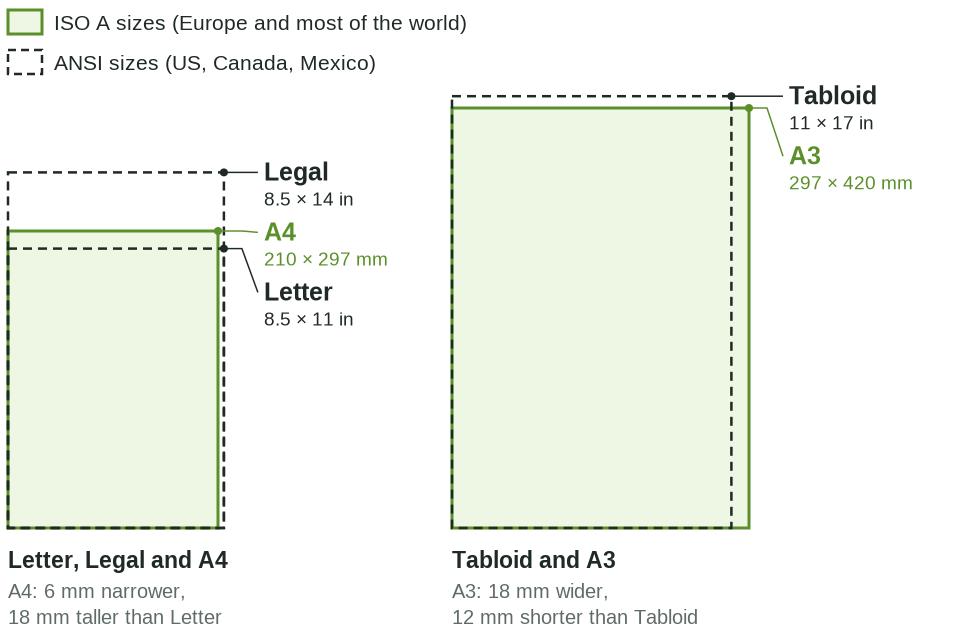 Letter, Legal and A4, and Tabloid and A3, drawn to the same scale and lined up at the bottom left corner.
US paper sizes (ANSI)
In the US, Canada and Mexico, everyday paper sizes are named rather than numbered. Letter is the standard for documents, letterhead and most flyers; Legal is used for contracts and forms; Tabloid, also called Ledger when turned sideways, is the go-to size for small posters, menus and newsletters. The larger ANSI C, D and E sizes are mostly used for posters and architectural or engineering drawings.
| Size | Inches | Millimeters | Common uses |
|---|
| Half Letter | 5.5 × 8.5 | 140 × 216 | Booklets, notepads, small flyers |
| Letter (ANSI A) | 8.5 × 11 | 216 × 279 | Letterhead, documents, flyers |
| Legal | 8.5 × 14 | 216 × 356 | Contracts, forms, menus |
| Tabloid / Ledger (ANSI B) | 11 × 17 | 279 × 432 | Small posters, newsletters, menus |
| ANSI C | 17 × 22 | 432 × 559 | Posters, charts |
| ANSI D | 22 × 34 | 559 × 864 | Large posters, architectural drawings |
| ANSI E | 34 × 44 | 864 × 1118 | Engineering drawings, large posters |
 Letter (8.5 × 11 in) is the standard size for US letterhead and documents.
For every US size with exact dimensions, see our US paper sizes reference.
European paper sizes (ISO A series)
The A series is built on a single sheet: A0, which measures one square meter (841 × 1189 mm). Cut A0 in half across its long side and you get A1. Cut A1 in half and you get A2, and so on down the line. Because every sheet has the same proportions, an A4 design can be enlarged to an A3 poster or reduced to an A5 flyer without cropping or adding white space.
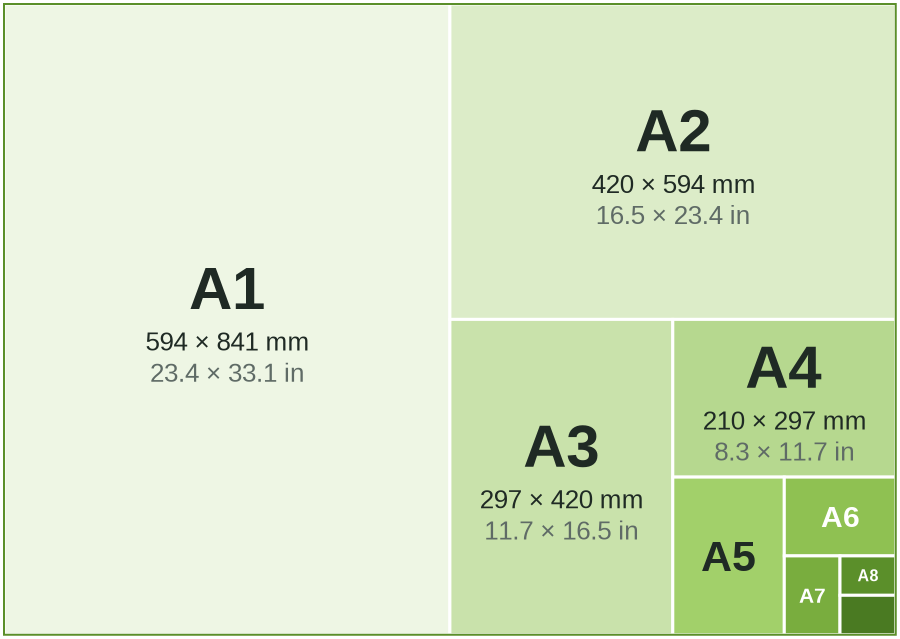 The outline is A0 (841 × 1189 mm). Each A size is exactly half of the one before it, drawn to scale.
| Size | Millimeters | Inches | Common uses |
|---|
| A0 | 841 × 1189 | 33.1 × 46.8 | Large posters, banners, technical drawings |
| A1 | 594 × 841 | 23.4 × 33.1 | Posters, wall planners, display boards |
| A2 | 420 × 594 | 16.5 × 23.4 | Posters, window displays |
| A3 | 297 × 420 | 11.7 × 16.5 | Small posters, menus, presentations |
| A4 | 210 × 297 | 8.3 × 11.7 | Letters, documents, flyers |
| A5 | 148 × 210 | 5.8 × 8.3 | Flyers, booklets, notebooks |
| A6 | 105 × 148 | 4.1 × 5.8 | Postcards, leaflets |
| A7 | 74 × 105 | 2.9 × 4.1 | Pocket flyers, tickets |
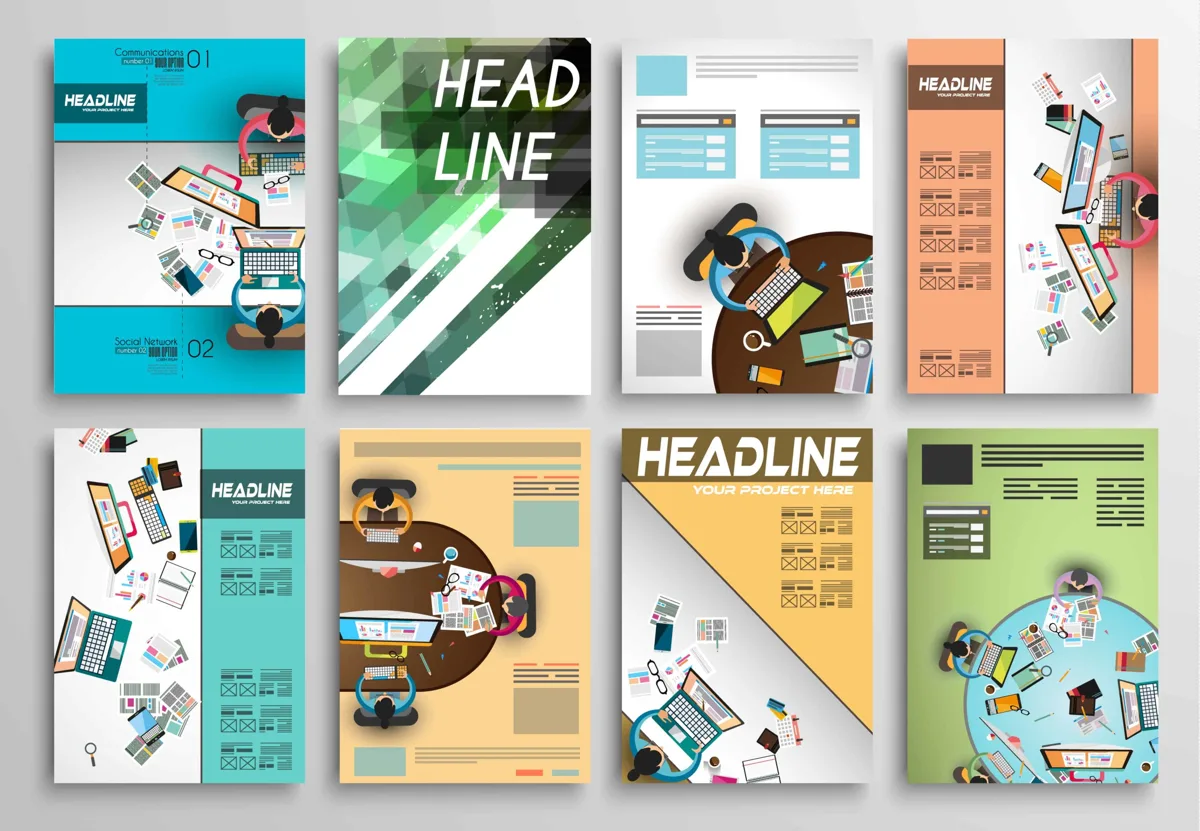 A4 and A5 are the most common flyer sizes outside North America.
Each size has its own page in our A series reference, starting with A4.
US vs European sizes side by side
No US size matches an A size exactly, but each has a close counterpart. Use this table when a client in one system asks for a size from the other, and remember that "close" still means the artwork has to be adjusted.
| ISO size | Closest US size | The difference |
|---|
| A0 (33.1 × 46.8 in) | ANSI E (34 × 44 in) | A0 is narrower and taller |
| A1 (23.4 × 33.1 in) | ANSI D (22 × 34 in) | A1 is wider and slightly shorter |
| A2 (16.5 × 23.4 in) | ANSI C (17 × 22 in) | A2 is narrower and taller |
| A3 (11.7 × 16.5 in) | Tabloid (11 × 17 in) | A3 is wider and shorter |
| A4 (8.3 × 11.7 in) | Letter (8.5 × 11 in) | A4 is narrower and taller |
| A5 (5.8 × 8.3 in) | Half Letter (5.5 × 8.5 in) | A5 is wider and shorter |
| A6 (4.1 × 5.8 in) | 4 × 6 in postcard | A6 is slightly wider and shorter |
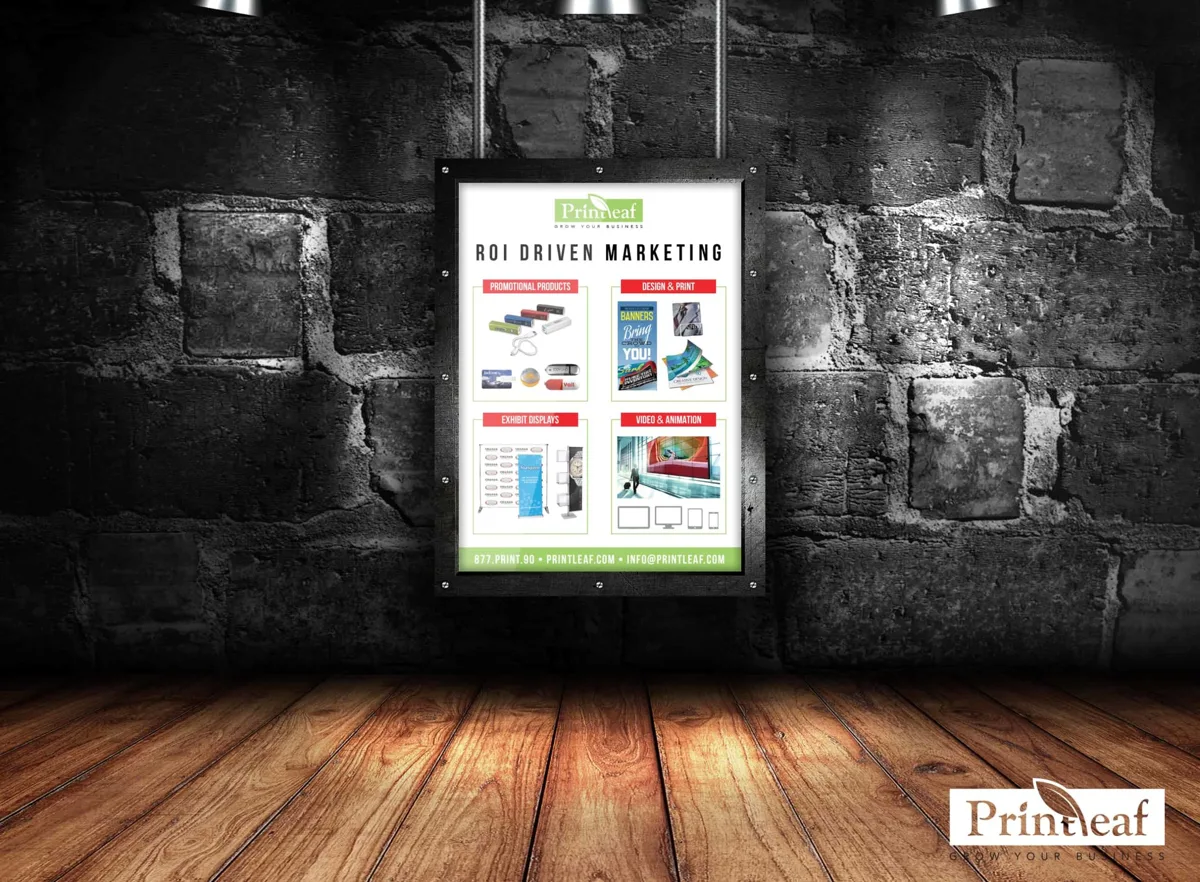 Poster frames are sold in both systems. Check whether yours is ANSI or A size before you print.
Business card sizes
Business cards are not part of either paper series, and they differ by region too. The standard US card is 3.5 × 2 in (89 × 51 mm). Much of Europe uses 85 × 55 mm, and some countries use the credit card size of 85.6 × 54 mm. If you are designing one card for use on both sides of the Atlantic, design to the size where it will be printed and handed out most. Our business card size reference lists the standard size in each country.
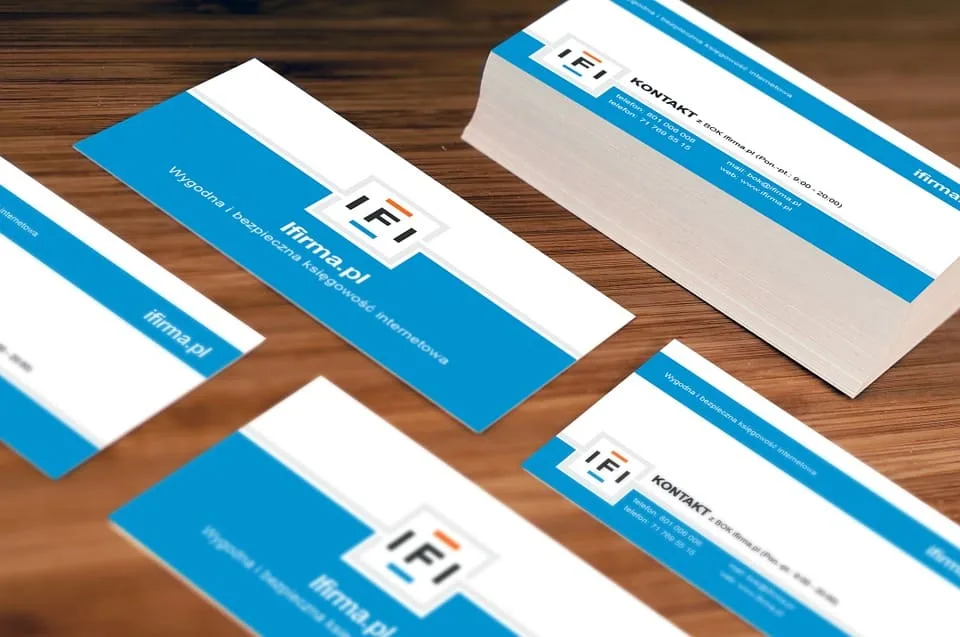 A US business card is 3.5 × 2 in; a European one is usually 85 × 55 mm.
Paper weights: pounds vs grams
The two systems also measure paper thickness differently. The US describes paper by its weight in pounds, split into text (thinner) and cover (card) stocks, while the rest of the world uses grams per square meter (gsm). Because text and cover pounds are measured on different sheet sizes, an 80 lb cover is much heavier than an 80 lb text. Grams per square meter is the easier way to compare.
| US weight | Metric (approx.) | Typical use |
|---|
| 20 lb bond | 75 gsm | Everyday copy paper |
| 24 lb bond | 90 gsm | Letterhead |
| 80 lb text | 118 gsm | Flyers, brochures |
| 100 lb text | 148 gsm | Premium flyers, booklet pages |
| 80 lb cover | 216 gsm | Booklet covers, light cards |
| 100 lb cover | 270 gsm | Postcards, invitations |
| 130 lb cover | 352 gsm | Thick business cards |
 Postcards are usually printed on 100 lb cover or heavier, around 270 gsm and up.
Tips for printing across both systems
- Give the size in both units. Write "A4 (210 × 297 mm)" or "Letter (8.5 × 11 in)" rather than just the name, so there is no room for guesswork.
- Don't just scale between Letter and A4. Because the shapes differ, scaling one to the other leaves a white strip or crops the edge. Keep text and logos at least 0.5 in (12 mm) from the edges, or set up a separate file for each size.
- Add bleed. For artwork that runs to the edge, US printers usually ask for 0.125 in of bleed on each side; European printers usually ask for 3 mm. The two are nearly the same.
- Match your envelopes. A Letter sheet folded in thirds fits a #10 envelope; an A4 sheet folded in thirds fits a DL envelope. See our US envelope sizes and international envelope sizes.
- Agree on the standard before you start. Confirm with your printer which system your files are set up in before anything goes to press.
Every other standard size, from billboards to book formats, is in our full paper size reference.
Last modified: November 6, 2026
